News

From: Microglial microRNAs mediate sex-specific responses to tau pathology

Microglial microRNAs mediate sex-specific responses to tau pathology

A new discovery published in Nature Neuroscience showed that male and female microglia expressed different sets of microRNAs at baseline and in response to tau pathology. Led by graduate student Lay Kodama in Gan lab, the study found that removal of microRNAs exacerbated tau aggregates in male but not in female tauopathy mice.

On the single cell level, only male, but not female, mice had increased number of disease associated microglia (DAMs) and decreased homeostatic microglia after...

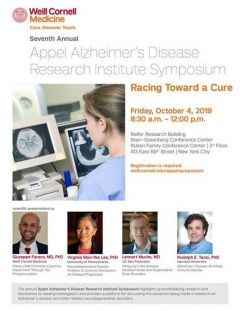
Appel Symposium Flyer

Seventh Annual Appel Alzheimer's Disease Research Institute Symposium to be held on October 04, 2019

The Seventh Annual Appel Alzheimer's Disease Research Institute Symposium is scheduled on Friday, October 4th, 2019 from 8:30AM - 12:00 PM at the Belfer Research Building, Starr-Greenberg Conference Center/ Ruben Family Conference Center on the 3rd Floor. 

This is an outstanding annual event hosted by Dean Choi, Appel Alzheimer's Institute and the Feil Family BMRI. Dr.Li Gan, Director of the Appel Institute will open the symposium, followed by four cutting edge scientific presentations...


Graphical Image

New article in Neuron shows how dementia-linked mutant tau disrupts neuronal activity homeostasis

Noah Guy Lewis Guiberson

Graduate Student Awarded the Markey Graduate School of Medical Science Fellowship

Noah Guy Lewis Guiberson a graduate student within Dr. Jacqueline Burre's lab has been awarded the "Markey Graduate School of Medical Science Fellowship” the fellowships recognize exemplary academic and research achievements as a Weill Cornell Graduate Student trainee.

Noah's Project Summary: "Mutations in Munc18-1 (encoded by the STXBP1 gene) cause a spectrum of neurodevelopmental disorders known collectively as STXBP1-Encephalopathies (STXBP1-Es). STXBP1-Es are characterized by...

Samantha Meadows

Samantha Meadows Receives the 2019 National Science Foundation Graduate Research Fellowship

Astrocytes have many functions in the brain and have recently been shown to modulate cognition. However, it remains unclear exactly how astrocytes affect cognitive function and if those mechanisms are impaired by aging or disease. The Orr laboratory is focused on understanding these phenomena in mice, with the goal of preventing cognitive decline in human disease. Samantha is a 2nd year graduate student in the Neuroscience Graduate Program at Weill Cornell and a member of the Orr laboratory...

Weill Cornell Medicine Helen & Robert Appel Alzheimer’s Disease Research Institute 413 E. 69th St. New York, NY 10021